
Coombe Hill Infant School
Mathematics
Curriculum Intent
At Coombe Hill Infants we believe that all children are born mathematicians.
We believe teaching for mastery is the most effective approach for our children to become confident and proficient mathematicians. The National Centre of Excellence in Teaching Mathematics (NCETM) states:
“Mastery means pupils of all ages acquiring a deep, long-term, secure and adaptable understanding of the subject. The phrase ‘teaching for mastery’ describes the elements of classroom practice and school organisation that combine to give pupils the best chance of mastering maths.”
Teaching for Mastery means pupils are taught through whole-class interactive teaching where there is a key focus on all children working together, on the same lesson content, at the same time. This ensures that all children can master concepts before moving to the next part of the curriculum sequence, allowing no pupil to be left behind.
The fundamental characteristics that underpin teaching for mastery are outlined as the 5 Big Ideas and include: coherence, representation and structure, variation, fluency and mathematical thinking.
1) Coherence - Teaching is designed to enable a coherent learning progression through the curriculum, providing access for all pupils to develop a deep and connected understanding of mathematics that they can apply in a range of contexts.
2) Representation and structure - Teachers carefully select representations of mathematics to expose mathematical structure. The intention is to support pupils in ‘seeing’ the mathematics, rather than using the representation as a tool to ‘do’ the mathematics. These representations become mental images that students can use to think about mathematics, supporting them to achieve a deep understanding of mathematical structures and connections.
3) Variation - The purpose of variation is to draw closer attention to a key feature of a mathematical concept or structure through varying some elements while keeping others constant.
● Conceptual variation involves varying how a concept is represented to draw attention to critical features. Often more than one representation is required to look at the concept from different perspectives and gain comprehensive knowledge.
● Procedural variation considers how the student will ‘proceed’ through a learning sequence. Purposeful changes are made in order that pupils’ attention is drawn to key features of the mathematics, scaffolding students’ thinking to enable them to reason logically and make connections.
4) Fluency - Efficient, accurate recall of key number facts and procedures is essential for fluency, freeing pupils’ minds to think deeply about concepts and problems, but fluency demands more than this. It requires pupils to have the flexibility to move between different contexts and representations of mathematics, to recognise relationships and make connections, and to choose appropriate methods and strategies to solve problems.
5) Mathematical Thinking - Mathematical thinking is central to how pupils learn mathematics and includes looking for patterns and relationships, making connections, conjecturing, reasoning, and generalising. Pupils should actively engage in mathematical thinking in all lessons, communicating their ideas using precise mathematical language.
At Coombe Hill Infants, we follow the National Curriculum for Maths and materials from the NCETM to enable us to deliver a progressive, dynamic and relevant curriculum. We also use the NCETM mastering number programme across our school to develop mathematical fluency.
Implementation
Across our school, pupils are taught through whole-class interactive teaching where teachers use a small step journey approach and then small groups to tailor instruction for children who need support on different aspects of content. This approach develops deep and sustainable knowledge and understanding that enables pupils to be able to reason about a concept, make connections and build fluency.
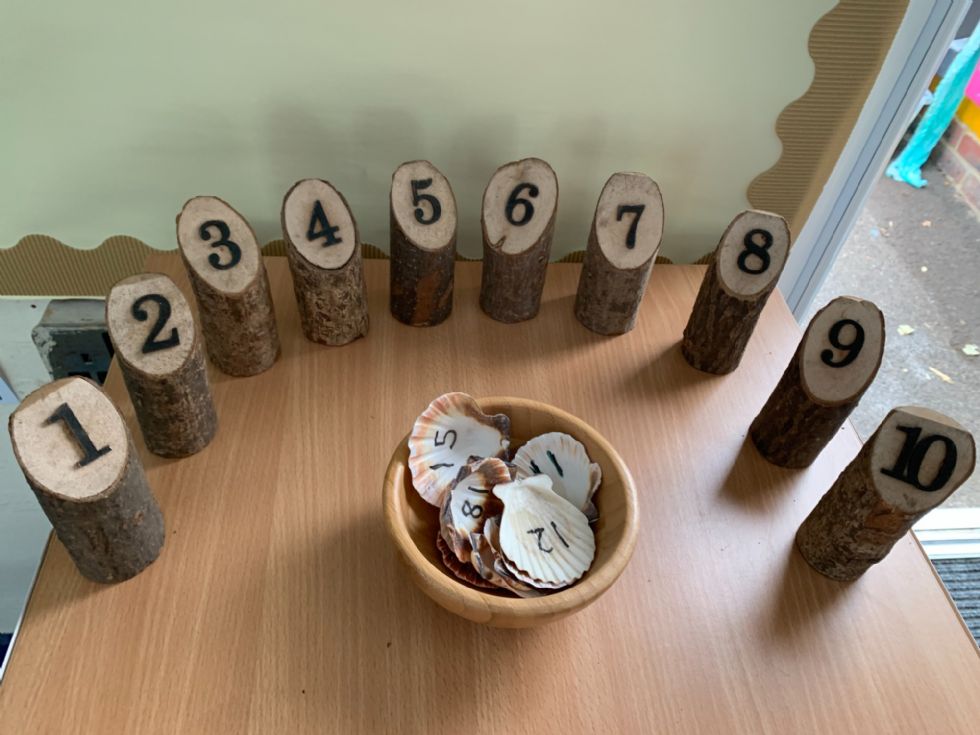
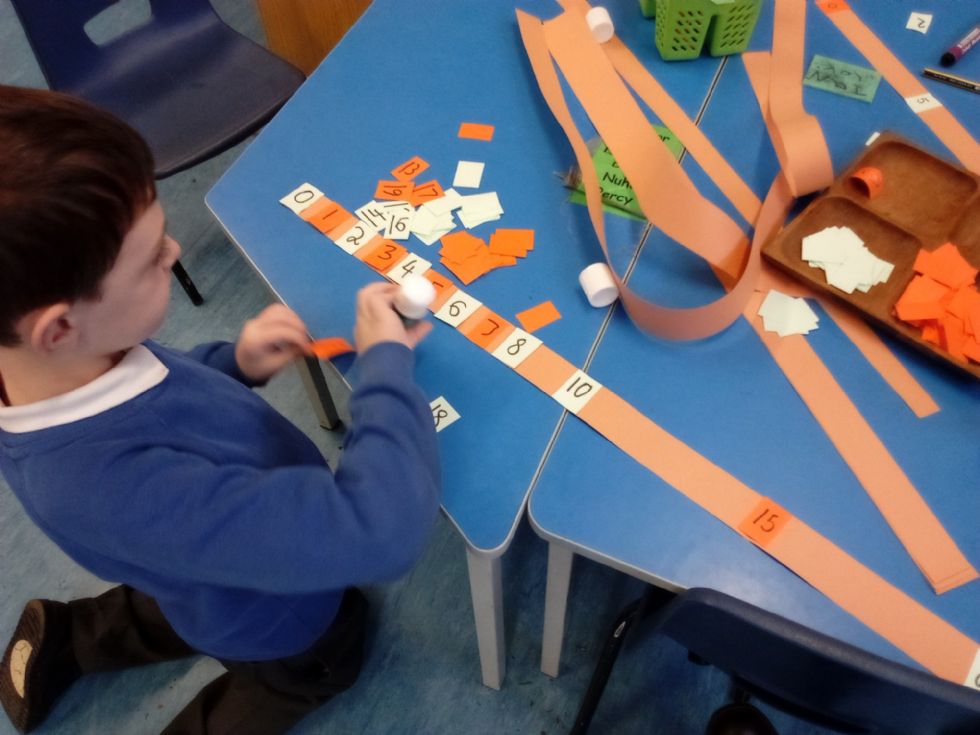
To enhance mathematical learning for our children we allow them access to a variety of tools to allow children to explore all areas of mathematics, and use of our outdoor provision are maximised to develop and reinforce mathematical ideas. For example the use of appropriate tools may include manipulatives, measuring items, scales, construction materials, puzzles, sorting and pattern materials.Through observing children’s play, the adults will identify ‘teachable moments’ in which they can join the play to add to the discussion, reinforce mathematical vocabulary, and encourage problem-solving. In Reception and Year 1, continuous provision provides daily opportunities to explore and learn maths in different ways.
Manipluatives and representations
Representations define how we ‘show’ children maths, they are a key interlinking step to link concrete to abstract and are sometimes referred to as pictorial representations.
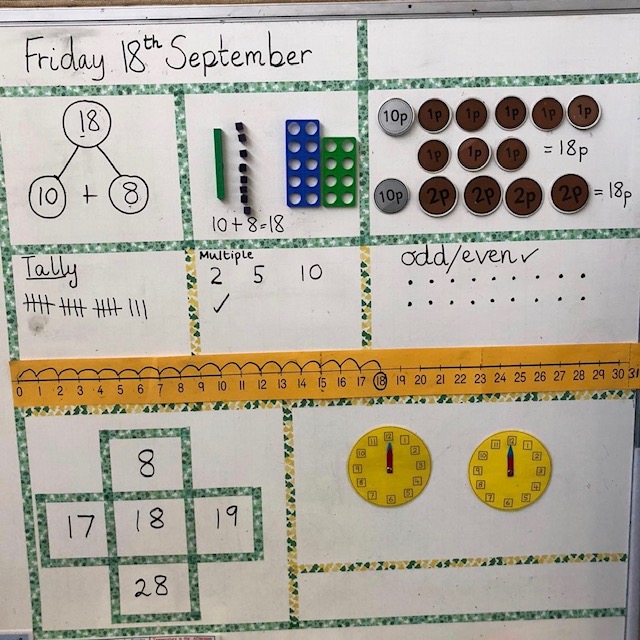
Manipulatives are crucial when introducing new concepts at the ‘concrete’ stage e.g. Tens frames, Dienes, Numicon, Cuisenaire rods, pegs, straws, geoboards, place value cards, dominoes, cards, dice, bead strings, Rekenraks, two-coloured counters, place value counters, number sticks, tens frames.
As the children progress through the school they need to move back and forth between the use of Concrete (doing, see above), Pictorial (seeing, visual representations e.g. bar modelling, pictures & diagrams) and Abstract (numbers, symbols, maths notation) throughout the teaching. Resources are carefully chosen and planned for by our teachers and are available for all children.
Many of the manipulatives above can be drawn out by children to show their learning and understanding. They are taught how to use these representations and are encouraged to use them all the way through the school.

Mathematical Problem Solving
Our aim is to build confident and resilient mathematicians at Coombe Hill Infants. Mathematical problem solving activities are therefore an integral part of our maths curriculum. Mathematical problem solving involves using mathematical knowledge, logic and reasoning to tackle unfamiliar problems. At Coombe, we use mathematical problem-solving to encourage children to think mathematically. Problem Solving gives pupils the opportunity to use their mathematical skills and knowledge to solve mathematical challenges and real-world problems.
Mathematical Problem solving gives children the confidence to:
-
develop critical thinking; notice and have a go;
-
talk about their understanding of a problem;
-
notice patterns, make connections and generalise;
-
take risks and learn from mistakes;
-
reflect on and make informed decisions;
-
share their ideas and justify methods;
-
work systematically
-
check their solutions.
Key Vocabulary and Questioning
Key vocabulary is mapped out and explicitly taught in every lesson. Highlighting new vocabulary in blue, to draw children’s attention to it. Pupils explore knowledge and conceptual understanding through engaging activities and an introduction to relevant, specialist vocabulary.
Teachers use a range of questions to support children’s learning. Inquiry-based questions enable children to discover and explore mathematical concepts and relationships. Teachers use the question ‘What do you notice?’ to encourage children to share without high stakes, this not only enables children as young as reception to notice mathematically but also to share their mathematical thinking.
When a child experiences a difficulty or makes a mistake they are asked to tell their teacher what they do know. This approach encourages children to ask themselves ‘What do I know and how can I use it?’. Open-ended questions give children confidence and encourages diverse perspectives, promotes deeper thinking and allows students to make connections whilst expressing their reasoning.
Oracy in maths
Our curriculum design allows for as many speaking opportunities as possible as our teachers understand that speaking and listening are at the heart of language. Not only are they the foundations for reading and writing, they are also essential skills for thinking and communication. Our teachers are role models for good spoken English, using ambitious vocabulary and correct grammar. Children are encouraged to read aloud, discuss ideas with their peers and teachers, engage with and learn new vocabulary to extend their spoken and receptive vocabulary.
Inclusion
Adopting the Teaching for Mastery approach enhances inclusivity by ensuring the majority of children master small steps of learning together. However, we understand that some children may need more bespoke changes to their everyday provision. In maths, we tailor instruction to meet individual children's needs and ensure all students have access to adaptations they need including different manipulatives or equipment. Pupils may have access to pre teaching, interventions or catch up activities to ensure they make good progress.
Impact
Our aim at Coombe Hill Infants is that our pupils develop curious minds, reasoning skills and an unquenchable thirst for knowledge through a love of maths. We believe that our children will have the necessary tools to confidently, critically and meaningfully question and explore the mathematical world around them. Our aim is for the children at Coombe to become critical thinkers with a range of problem-solving skills and mathematical fluency to enable them to have future academic success, successful careers and a lifelong love of the subject.