
Coombe Hill Infant School
Reading and Phonics
Curriculum Intent
We believe in inspiring every child to learn to read and to develop a lifelong love of reading for pleasure. Reading is an essential life skill and sits at the heart of our curriculum.
‘Reading for pleasure is the single most important indicator of a child’s success.’ (OECD 2002)
Our aim is for all children to enjoy reading, read widely and often, and develop age-appropriate fluency, prosody and comprehension. Our reading curriculum offers a balanced and engaging approach that nurtures both decoding and comprehension skills. As a CLPE Associate School, we place high-quality texts at the centre of our teaching to excite, challenge and motivate pupils, helping them build resilience and stamina as readers.
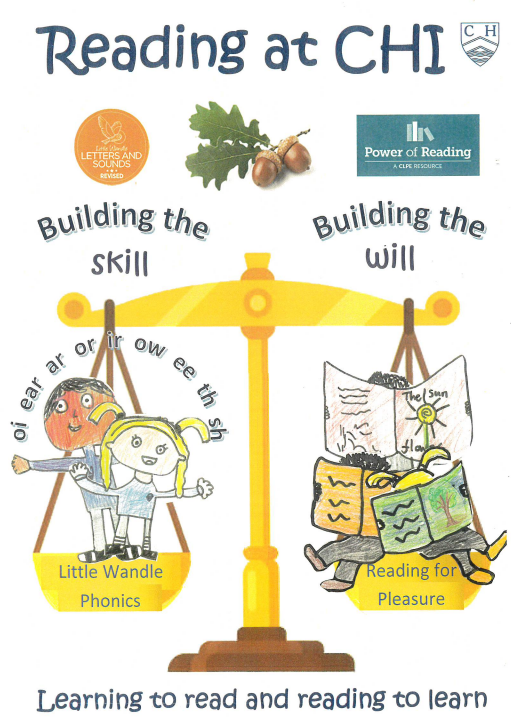
At Coombe Hill Infants’ School, we believe all children can become confident, fluent readers and writers. This is why we teach phonics through Little Wandle Letters and Sounds Revised, a systematic synthetic phonics programme. Phonics teaching begins in Reception and follows the carefully structured Little Wandle progression, ensuring that children build on their growing knowledge of the alphabetic code and master the skills needed to read and spell as they move through school.
‘The will influences the skill and vice versa.’ (OECD 2010)
Curriculum Implementation
We have a clear and ambitious vision for providing high quality teaching of phonics and reading. This includes:
-
A rigorous, sequential approach to teaching phonics and reading
-
Reading materials closely matched to children’s phonic knowledge
-
Regular assessments carried out half termly - gaps addressed quickly and effectively
-
A sharp focus on phonics knowledge and language comprehension which are necessary to read and give children the skills to communicate - foundations for future learning
Daily phonics lessons in Reception and Year 1
-
We teach phonics for 30 minutes a day. In Reception, we build from 10-minute lessons, with additional daily oral blending games, to the full-length lesson as quickly as possible. Each Friday, we review the week’s teaching to help children become fluent readers.
-
Children make a strong start in Reception: teaching begins in Week 2 of the Autumn term and reading groups begin in Week 4.
-
As each sound is taught, the children begin to segment (sound out) and blend (put the letters together to make words) so they can read and write. As soon as a child is taught “s, a, t, p, i n etc, they will learn to segment and blend the letters to read and write the words sat, sit pin, pat, tap tin.
-
Children in Reception are taught to read and spell words using Phase 2 and 3 GPCs, and words with adjacent consonants (Phase 4) with fluency and accuracy.
-
Children in Year 1 review Phase 3 and 4 and are taught to read and spell words using Phase 5 GPCs with fluency and accuracy.
-
Children in Year 2 review Phase 5 learning and begin our Fluency Reading Programme and Spelling Programme.
Daily Keep-up lessons ensure every child learns to read
-
Any child who needs additional practice has daily Keep-up support, taught by a fully trained adult. Keep-up lessons match the structure of class teaching, and use the same procedures, resources and mantras, but in smaller steps with more repetition, so that every child secures their learning.
-
We timetable daily phonics lessons for any child in Year 2 who is not fully fluent at reading or has not passed the Phonics Screening Check. These children need to catch up, so the gap between themselves and their peers does not widen. We use the Little Wandle Letters and Sounds Revised assessments to identify the gaps in their phonic knowledge and teach them using the Rapid Catch up resources.
As a result, all our children are able to tackle any unfamiliar words as they read. At Coombe Hill Infants School, we also model the application of the alphabetic code through phonics in shared reading and writing, both inside and outside of the phonics lesson and across the curriculum. We have a strong focus on language development for our children because we know that speaking and listening are crucial skills for reading and writing in all subjects.
Phonics Screening Check
In June, all Year 1 children take part in the National Phonics Screening Check, which assesses their ability to use phonics to decode words. The check consists of 20 real words and 20 pseudo-words (sometimes called “alien words”) to ensure pupils are applying their phonic knowledge rather than relying on memory. Parents receive their child’s results with the end-of-term report, and any child who does not meet the expected standard will retake the check in Year 2. We provide targeted support throughout Year 2 to help children close any gaps and build confidence in their reading skills.
Early Reading
Reading skills are explicitly taught using the Little Wandle Letters and Sounds Revised programme, which provides a consistent and systematic approach to early reading. Children read in small groups three times a week, focusing on decoding, prosody (reading with expression) and comprehension. Books are carefully matched to each child’s phonic stage, ensuring they can apply the sounds they have learned and build confidence as fluent, independent readers.
Reading for Pleasure
Our curriculum provides reading opportunities in all areas of learning. Our library is used by all the children and has been stocked with a diverse range of high quality texts to engage all readers. We fill our days with stories, poetry and rhyme. We aim for a 5-a-day approach to reading. Each class has a poem at the beginning of the day, a special story time at the end of the day, as well as many opportunities for whole class reading throughout the day. The children read instructions, look at books related to their learning, read the day and the date on the board, refer to the class visual timetable, access labelled resources etc and read text from the Interactive White Board.
We teach the children to read, so they can read to learn.
Oracy in all subjects
Our curriculum design allows for as many speaking opportunities as possible as our teachers understand that speaking and listening are at the heart of language. Not only are they the foundations for reading and writing, they are also essential skills for thinking and communication. Our teachers are role models for good spoken English, using ambitious vocabulary and correct grammar. Children are encouraged to read aloud, discuss ideas with their peers and teachers, engage with and learn new vocabulary to extend their spoken and receptive vocabulary.
Impact
The teaching of phonics and reading at our school has a strong and lasting impact on pupils’ learning. Children develop secure decoding skills, enabling them to read with increasing fluency, accuracy and confidence. As their comprehension grows, pupils engage more deeply with texts, which supports their wider learning and enhances their vocabulary and writing. Most importantly, our focus on high-quality reading experiences fosters a love of books that stays with children as they move through school and beyond.